
40-Hertz and Traumatic Brain Injury (TBI)
- iniyanjose
- Feb 16
- 3 min read

Can a 40-Hz “rhythm” help the injured brain recover? What gamma entrainment research suggests for TBI.
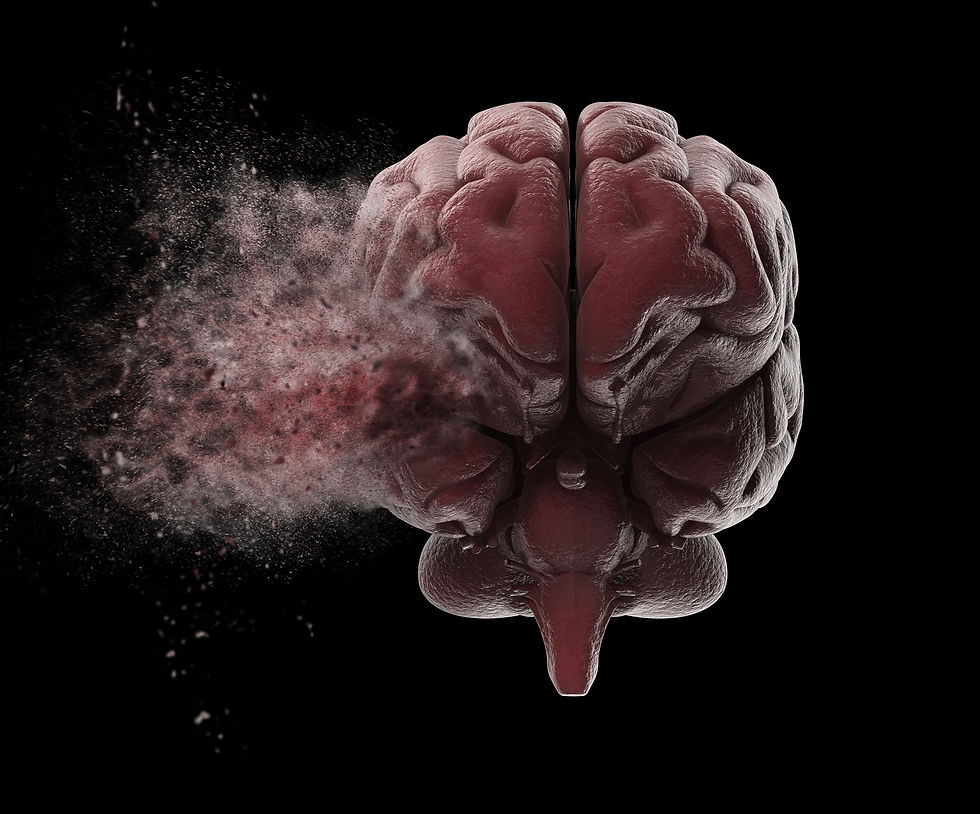
After a traumatic brain injury (TBI) - whether from a fall, sports collision, car crash, or blast exposure - people often describe the aftermath in the same way: brain fog, slowed thinking, memory lapses, fatigue, sleep disruption, irritability. The injury may be “mild” on a scan, yet life can feel anything but mild.
One reason recovery can be so complicated is that TBI doesn’t just damage tissue - it can disrupt how brain networks communicate, including the brain’s natural electrical rhythms.
A quick primer: what is “gamma” and why 40-Hz?
The brain communicates through patterns of activity that oscillate at different speeds. Gamma is a faster rhythm (often discussed roughly in the 30–100 Hz range). Scientists associate gamma activity with network coordination, like a timing signal that helps different brain regions work together.
40-Hz has become a focal point because it’s a reliably inducible “gamma-like” rhythm using sensory stimulation (light or sound pulsing 40 times per second). This is often called gamma entrainment: offering the brain a steady beat and seeing if its activity synchronizes to it.
What does this have to do with traumatic brain injury?
After TBI, researchers have observed changes in gamma activity and in the circuits that generate it. That leads to a fascinating (and still early) question:
If TBI disrupts timing and coordination, could rhythmic stimulation help restore it—at least in some contexts?
What we’ve seen in animal research so far
A 2023 study in mice tested 40-Hz light flicker after TBI and reported several notable findings:
TBI was associated with reduced “low gamma” activity in the hippocampus (a region central to memory).
40-Hz light flicker (but not random flicker or 80-Hz) restored gamma activity and reversed cognitive impairment in behavioral tests.
The authors also reported improvements in synaptic plasticity measures (LTP) and changes suggesting reduced over-excitation in hippocampal circuits.
In a separate rat study, researchers reported that TBI decreased gamma oscillations on the injured side of the brain, and that one week of 40-Hz “blue LED” therapy was associated with improved neurological scores and partial normalization of gamma-related EEG measures.
These are not “cures.” But they do offer an important proof-of-concept: rhythm-based stimulation can influence post-injury brain dynamics and behavior—at least in controlled animal models.
How might it work?
Different research teams propose different mechanisms, and we should treat them as hypotheses—not settled facts. But a few themes keep showing up:
Network timing support: If injury disrupts coordinated firing, a rhythmic input may help re-align timing.
Plasticity pathways: The mouse TBI study linked 40-Hz stimulation to measures of synaptic plasticity (how the brain “relearns”).
Clearance and brain fluid dynamics: A 2024 paper on 40-Hz light flicker described increased glymphatic flow mechanisms and noted effects in models relevant to brain injury and ischemia—an area that’s gaining attention, though translation to human TBI is not yet established.

What about humans with TBI?
Here’s the honest answer: human evidence for gamma entrainment in TBI is still limited, and we need well-designed clinical trials before anyone can claim meaningful clinical benefit.
But clinical research is moving. For example, a VA-sponsored study (Active–Recruiting) is investigating gamma-band EEG abnormalities in blast-exposed Veterans and testing whether brief 40-Hz auditory stimulation can remediate gamma markers.
That matters because it signals the field is shifting from “interesting idea” to “testable intervention”—with measurable brain outcomes.
The takeaway
Gamma entrainment (including 40-Hz stimulation) is an emerging research area for TBI—promising enough to study seriously, but still early. If you’re watching neuroscience, recovery, and brain health innovation, this is a space to follow.
Safety note: Flickering light is not appropriate for everyone, especially anyone with photosensitive seizure risk. Always consult a qualified clinician for health decisions.


Comments